The Dummies Guide To Gaining Muscle
There are already enough complicated guides to building muscle so let’s not add another one. Today we’re bringing it back to the basics, how to build muscle, how to adjust your training to keep adding muscle and how to optimise your nutrition to suit.
What causes muscle growth?
Gaining muscle doesn’t require some immensely complicated workout routine or intense nutritional strategy, if you’re doing the basics steps needed to gain muscle, you will gain muscle.
Before we dive into the steps needed, it’s important to understand why we gain muscle in the first place. Our body is an inherently lazy thing and it doesn’t like to change unless given a reason to, after all, why expend energy to change unless there is a reason to? Knowing that, we know that unless we give our body a reason to adapt, in this case, through exercise, our body won’t change and gain muscle. However, when given the right signal to grow, and time to recover you will gain muscle.
The proper name for muscle growth is muscle hypertrophy (hyper = increase, trophy = growth). and at its most basic level, is caused by 3 different mechanisms: Mechanical tension, metabolic stress and muscle damage
Mechanical tension
The simplest mechanism to explain, mechanical tension is caused by an external load (dumbbell, barbell etc) being taken through a range of motion for a period of time with the longer the time spent under tension, the greater the mechanical tension. We have stretch receptors in our muscles called mechanoreceptors which seem to be sending off these signals to grow when stretched under a heavy load. The good news is that mechanical tension is a natural byproduct of lifting weights, as lifting weights in a coordinated manner causes enough mechanical tension to promote muscle growth.
Pro tip: Heavy exercises taken through a full range of motion are the most potent ways to increase mechanical tension
Metabolic stress
Ever felt that burning sensation in your muscle that keeps on building the longer you exercise? That feeling is metabolic stress and is another important factor for muscle growth as it triggers anabolic signalling cascades (similar to mechanical tension). For anyone who has had a ‘pump’ from training (also called transient hypertrophy), you’d be familiar with how usually exercises with higher reps facilitate it. This metabolic stress is often what bodybuilders are training for in their programs which is why so many of their programs utilise the 8-15 rep range; it works.
The most potent creator of metabolic stress is lifting moderate-light weights for higher reps as it causes a build-up of metabolites such as hydrogen ions and lactic acid. This buildup is caused by an insufficient blood supply to the muscle during these higher rep exercises (think of your muscle as a sponge which keeps squeezing the blood out with each contraction). This build-up of metabolites has a powerful anabolic effect on your body, which is why it’s such a potent stimulator for hypertrophy.
Pro tip: Metabolic stress can be easily increased by shortening your rest periods - Don’t cut your rest so short that you compromise your form.
Muscle damage
Muscle damage is an essential part of muscle hypertrophy being the main stimulus for muscle growth which is why it is often the main goal of an exercise program. Muscle damage is what the name implies, through exercising our muscles we cause microtrauma to our muscle tissue, making tiny little tears which our body will heal, and then some more so as to not get as damaged in the future.
Delayed Onset Muscle Soreness (DOMS) is the sore feeling in your muscles and often is caused by muscle damage. Often people continually try to give themselves DOMS through training to get this muscle damage but this is often detrimental to your training. As talked about in my previous blog post about fitness myths you shouldn’t be constantly getting sore muscles from your training unless you are new to a program, trying out new exercises or deliberately training harder than you normally would (called overreaching ). If you are recovering enough you shouldn’t be consistently getting DOMS to the degree that it’s negatively impacting your training. Too sore to train well = fewer gains
Pro tip: Eccentric exercises (the lowering portion of an exercise) causes more muscle damage and can be loaded heavier than a concentric exercise so adding specific exercises to target this can improve muscle growth.
In order to gain any muscle, strength or endurance your body needs to be trained harder than it has before.
General Adaptation Syndrome (GAS)
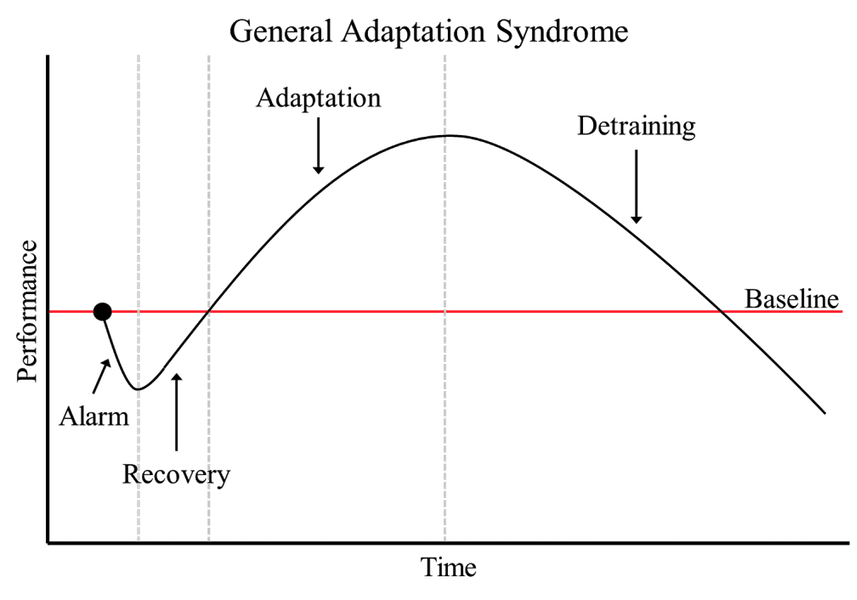
All of these mechanisms are important facilitators for muscle growth, but we need to take one step further back and look at why we adapt at all. A fancy name for a fairly intuitive concept, GAS refers to the fact that there need to be periods of rest, or low-intensity training following high-intensity training. You cant train at 100% all the time, and this is reflected in the GAS model. The reason for this is that the stress you have applied is traumatic, forcing your “injured” muscles to heal and then adapt. The recovery and overcompensation time must be taken so that further stress does not continue the downward spiral caused by repetitive bouts of trauma.
Alarm phase: When you exercise and through mechanical tension, metabolic stress or muscle damage send the signal to your body to adapt
Recovery phase: A period of low/no exercise phase which facilitates your body to adapt, or build more muscle than it did before so as to protect itself.
Adaptation phase: Your body has recovered and adapted so that the stimulus doesn’t damage it as much if it encounters it again.
Detraining phase: If you stop training or aren’t continuing to train at the same level, you begin to lose these adaptations, known as detraining.
The basics of a muscle growth program
An effective muscle building program doesn’t need to be complicated! If you are able to tick all or the majority of these boxes, you will have the basis of a very effective muscle-building program (listed in order of importance)
Progressive overload
— Don’t do the same weight, reps, sets, intensity or frequency every time you workout. Try to increase one variable at a time each week (e.g Increasing the weight by ~5% each week for an exercise)
Train at least 3x week
— Any less and you are at best maintaining your muscle mass, and at worst losing strength and size week by week.
Using ~6-8 exercises
— Too few and there aren’t enough stimuli for growth, too many and you won’t recoverUsing ~8-12 reps for ~ 2-4 sets per workout
- This seems to be the sweet spot for being able to cause metabolic fatigue, muscle damage and mechanical tension. Isolation exercises will generally use higher reps.
Exercise at an intensity of 60-85% of your 1RM
— Use a weight that you can do for 8-12 reps while leaving a few reps left in the tank (so shouldn’t be going to failure with each set)
Focusing on compound exercises over isolation exercises
— Exercises that require greater muscle recruitment create a greater stimulus for growth
Resting ~1.5-3 min between sets
— Resting below that range has been linked to lesser long term muscle gain due to fatigue building up (unable to train as much volume as if you rested longer)
Rest ~48 hours between exercising body parts
— Your muscle need time to recover, with the harder you train them, the longer you need to recover
Prioritisation principle
— Train the most important exercise first (aka, don’t put squats last on your leg day)
While I’d need a whole other blog post to go into the why of why these are important building blocks for a good program, the most important factor is that these steps have been the results of thousands of studies trying to find out what workouts help us gain muscle. The result? There is no perfect workout for muscle growth, rather a general set of rules which if followed is effective at promoting muscle hypertrophy.
Nutrition
When it comes to nutrition there are two main factors you need to consider before anything else for building muscle.
Are you getting enough calories? Your body needs to have enough calories to be able to build muscle, so you need to eat a surplus of ~250 calories a day if you’re trying to gain muscle. Our body doesn’t need a massive surplus to gain muscle, all you’ll be doing then is putting on unnecessary fat (which is another good reason not to ‘dirty bulk’.
Are you getting enough protein? Protein is an essential macronutrient for building muscle mass, being the building block for muscle tissue. Currently, guidelines for maximising muscular hypertrophy show that to maximise your gains you should aim to eat anywhere between 1.4-2.4g of protein per/kg body mass.
This means if you are an 80kg male, your maintenance calories is ~2300 calories so you should be eating around 2550 calories a day and between 112-190g of protein a day.
Take-home points
Muscle growth is caused by three factors: mechanical tension, muscle damage and metabolic fatigue.
You need to give your body a reason to gain muscle and if you’re not using progressive overload, your body has no reason to change
Recovery is just as important as training, prioritise rest and nutrition in order to optimise your training
There is no perfect workout, rather a lot of great workouts that follow similar rules - Trick is finding one that works for you
These guidelines for building a muscle hypertrophy program are more guidelines than actual rules, there is a near-infinite amount of variation you can add to your program, but the research is showing that the most effective programs are doing all or the majority of these things. Start off by trying to make sure you’re doing most of the things on the list, and then go from there.